Representation & Surrogation

LIS 5043: Organization of Information

Dr. Manika Lamba

Introduction

  • Two central concepts in the organization of information are representation and surrogation
  • Representation is a complex process. It is both the process and the product, depending on the context in which you are engaging with the concept
  • Surrogation is related to representation but can be thought of more as a process with a surrogate being the result of the surrogation process
  • Surrogates are objects that stand in place of something else, for example, a library card catalog record (MARC record) stands in place of the actual item in the library’s collection (such as book, cd, dvd) etc.
  • Whenever we create a surrogate, we have to decide what to represent (or to highlight) about the object and in the same instance, what NOT to represent about the object

Representation

  • Many types and levels of representation:

    • Representation of user's information needs

    • Representations of information objects

    • Representations of relationships among objects

    • Representations manipulated by systems

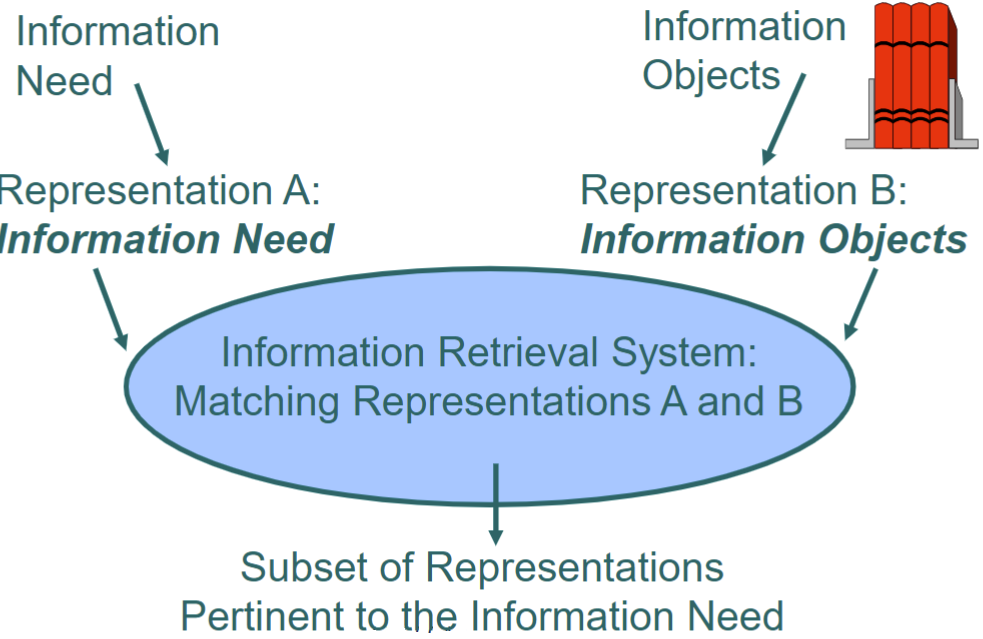
  • Ultimately, representations interact to connect users to information

Model of Information Retrieval
Library Paradigm for Representation

Representation answers two questions

  • What is the item?
    • Represent the container
    • Bibliographic representation
    • Descriptive, not evaluative
    • Uniquely identify/describe an object
    • Distinguish one object from another through metadata
  • What is the item about?
    • Represent the content
    • Subject representation
    • Identify topics, concepts, perspectives, etc.
    • Adequately represent object’s content so user can find the object based on search topic
    • CONTEXT??

Other questions…How good is it? How will it be useful to me?

Two Primary Challenges

  • How to individually represent information objects as concrete entities so they can be found when needed?
    • Container-oriented
    • Uniqueness-oriented
  • How to represent and relate information objects as sources of information on various subjects so they can be found by those in search of the information?
    • Content-oriented
    • Relationship-oriented

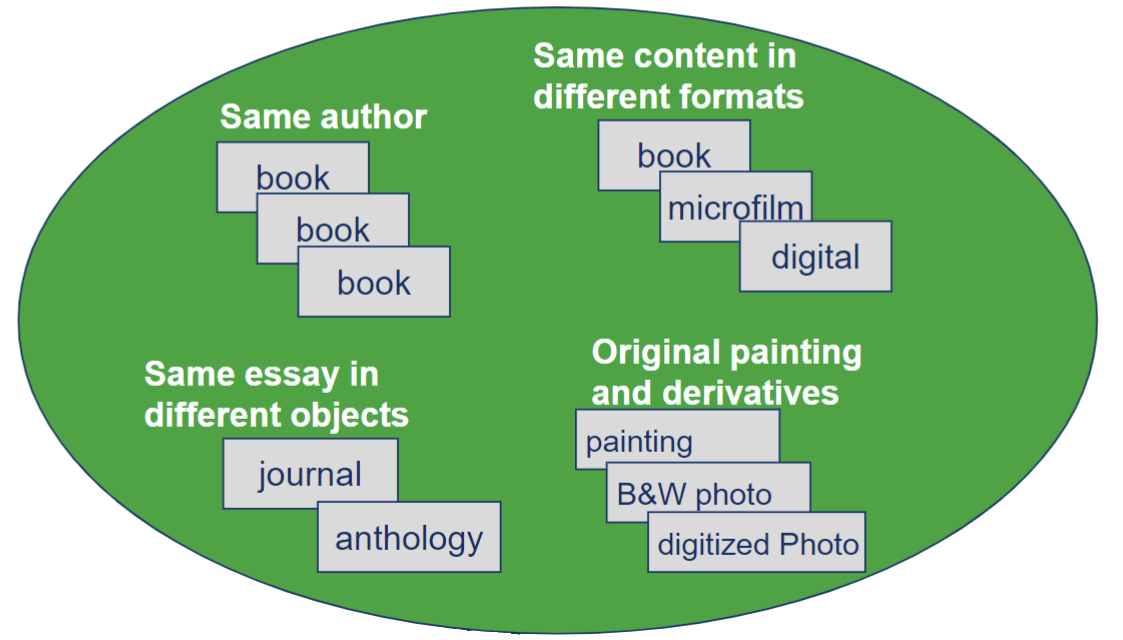
Relations in the Bibliographic Universe
Identifying Relationships

  • Separate containers, same content
    • Different formats
  • Separate containers, similar content
    • Translation, abridged, versions, editions
  • Seperate containers, same author, different content
    • Link together all objects by author
  • Seperate containers, different authors, similar content
    • Link together all objects by subject
  • Unique representations of container
  • Relationships established through various means
    • Name authority control
    • Controlled vocabulary

Bibliographic Tools (Instruments)

  • Mechanisms by which bibliographic control is established and maintained
  • Examples of tools (contain representations)
    • Library catalog
    • Bibliographic
    • Indexes to journal literature
    • Finding aids
  • Three functions of all bibliographic tools
    • Identification or finding
    • Collocation or gathering
    • Evaluation or selecting
  • Representations must support these functions

Representation Responsive to Users

  • What to users want to do?
    • Search?
    • Evaluate?
  • How do our representations support their tasks?
  • Library catalog representations support four generic user tasks (FRBR)
    • Find
    • Identify
    • Select
    • Acquire or obtain

Metadata and Metadata Schemes

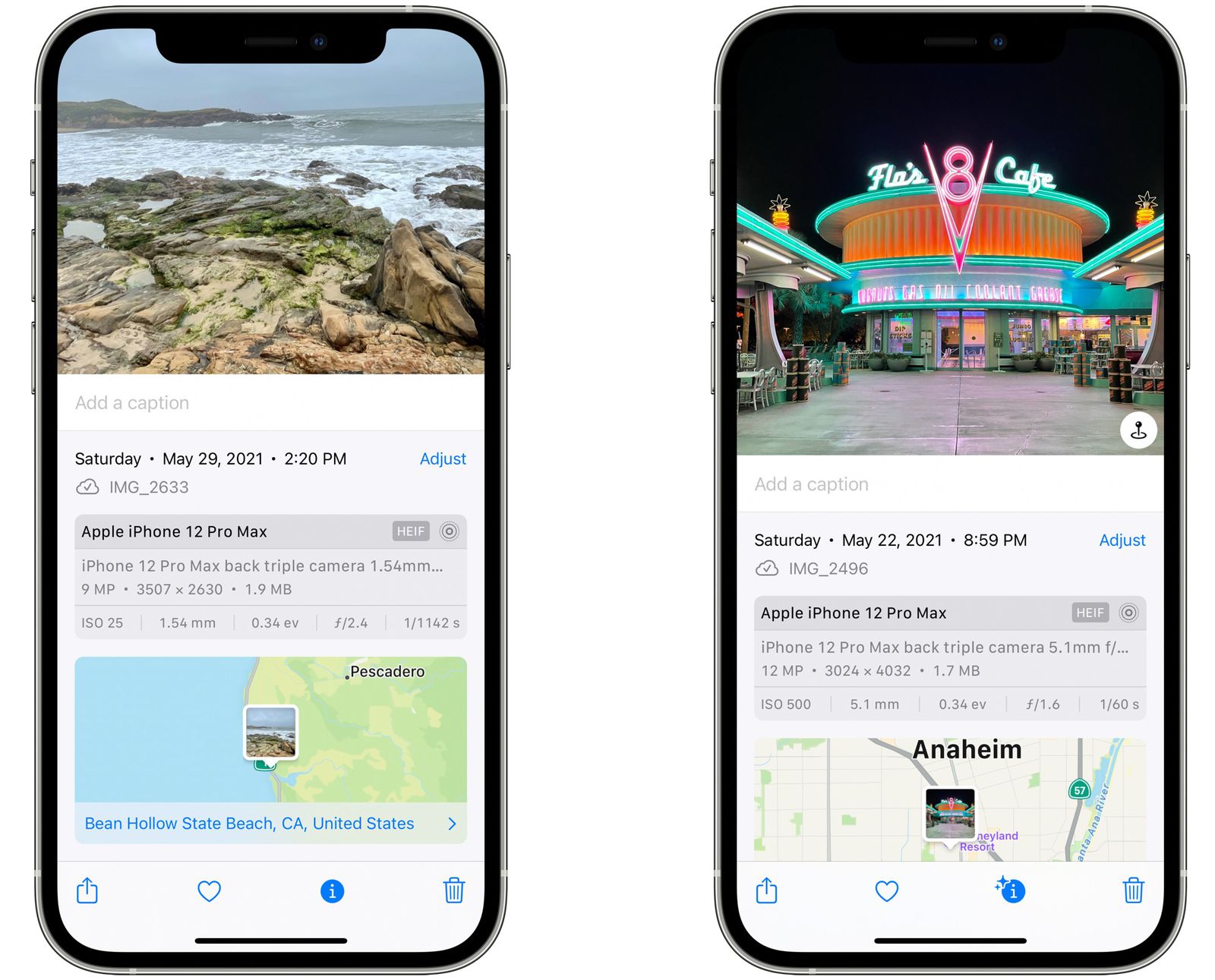
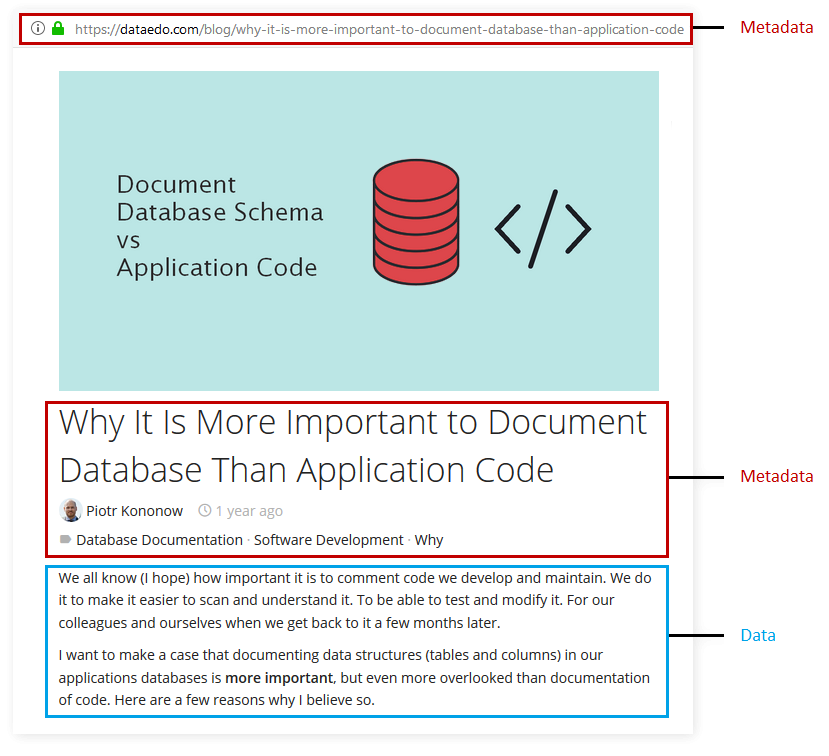
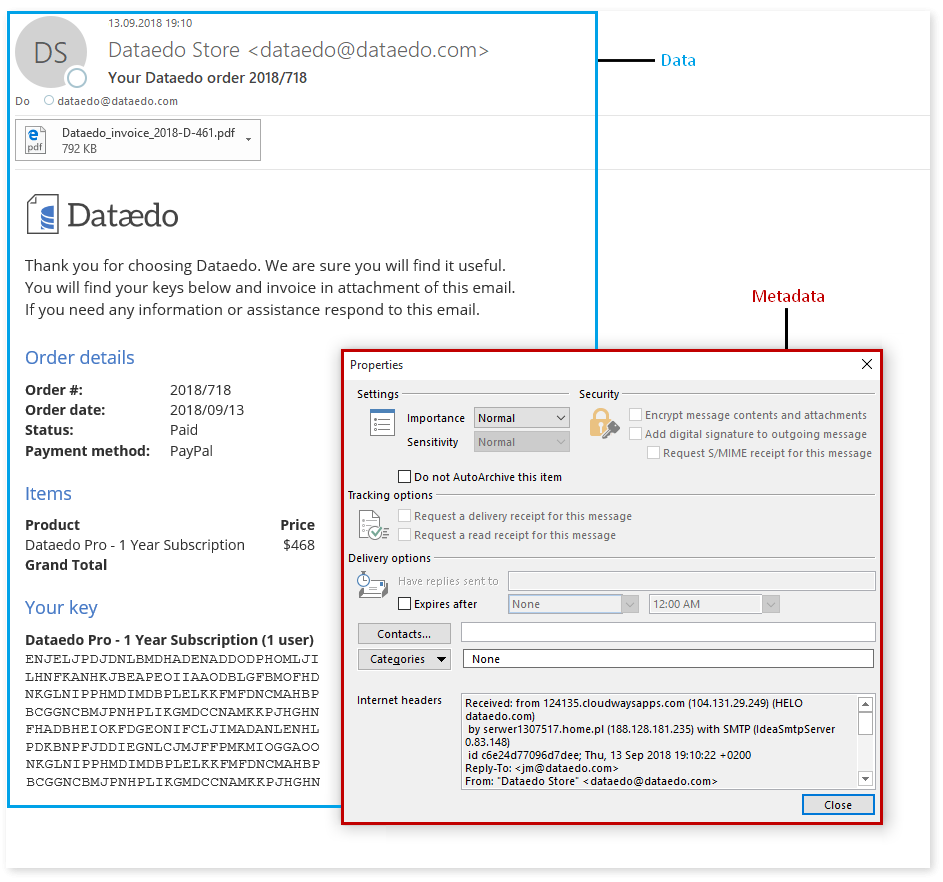
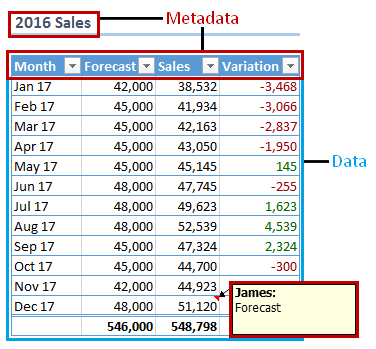
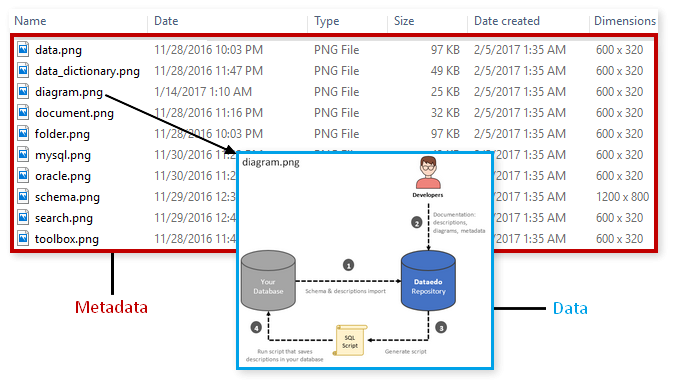
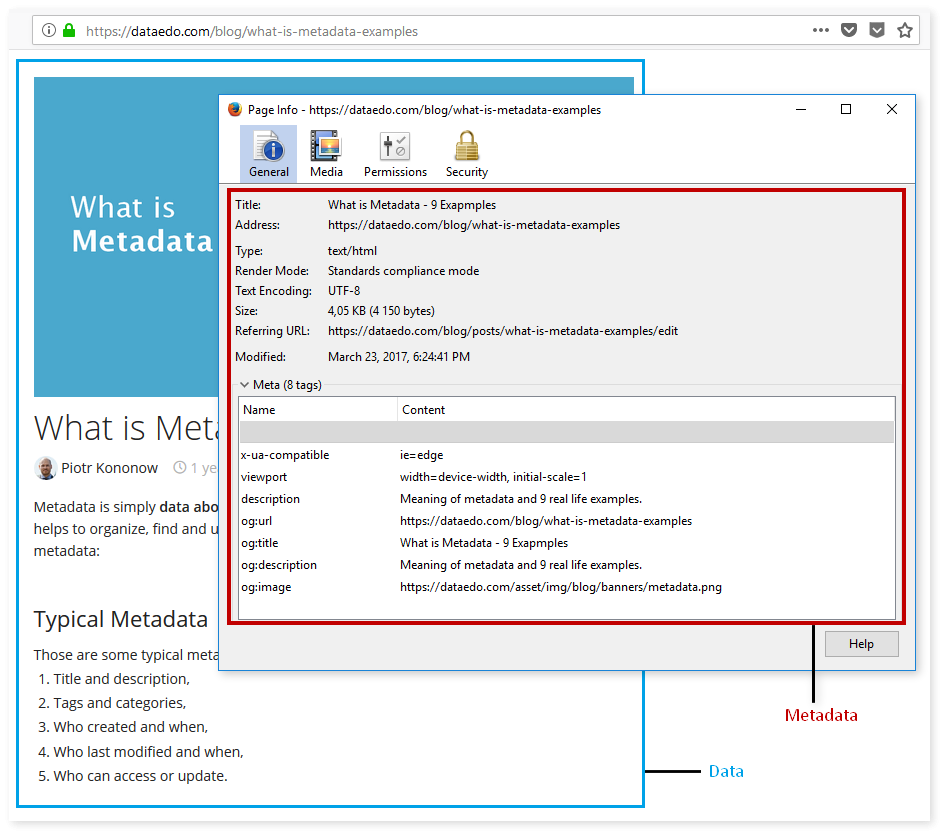
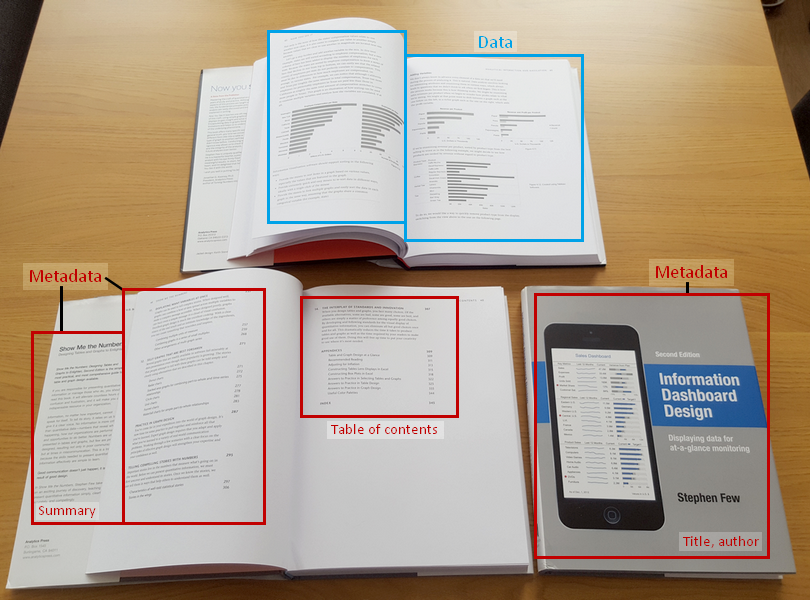
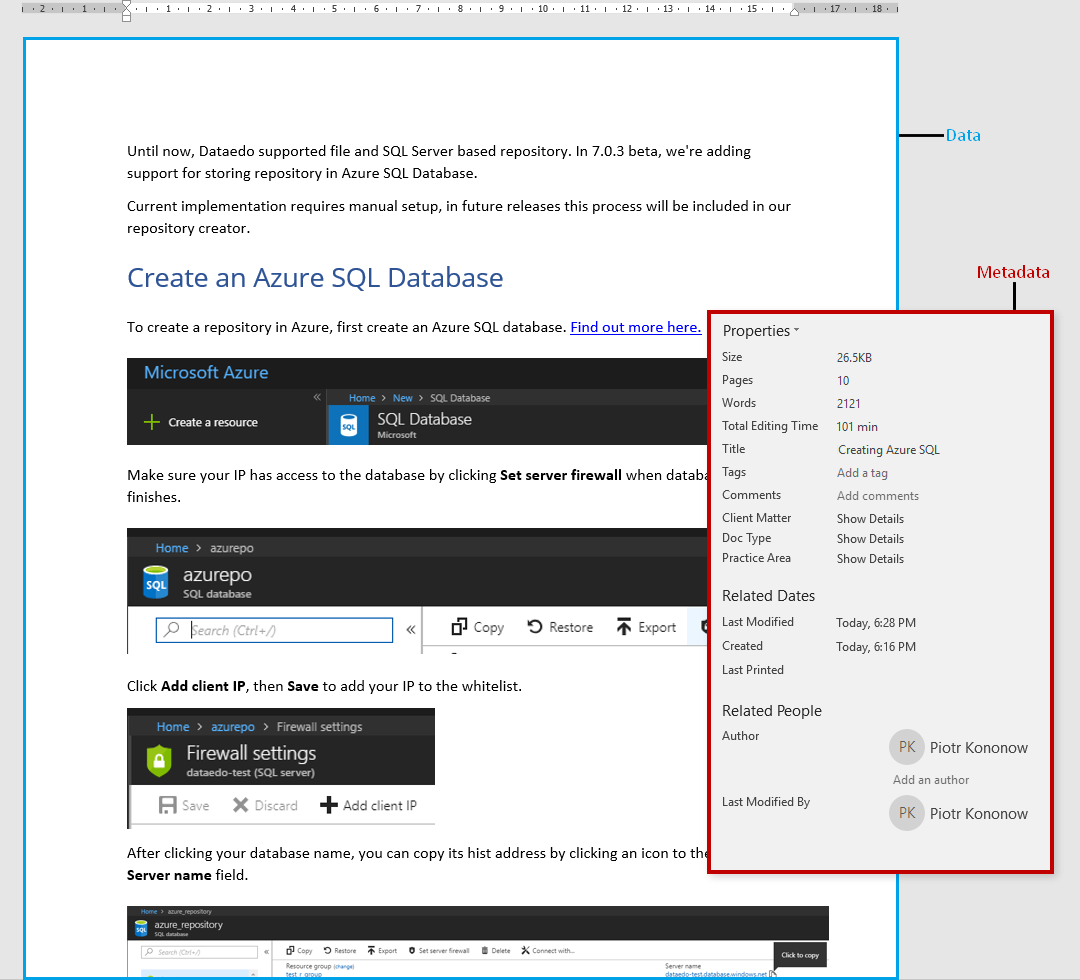
Data about an entity

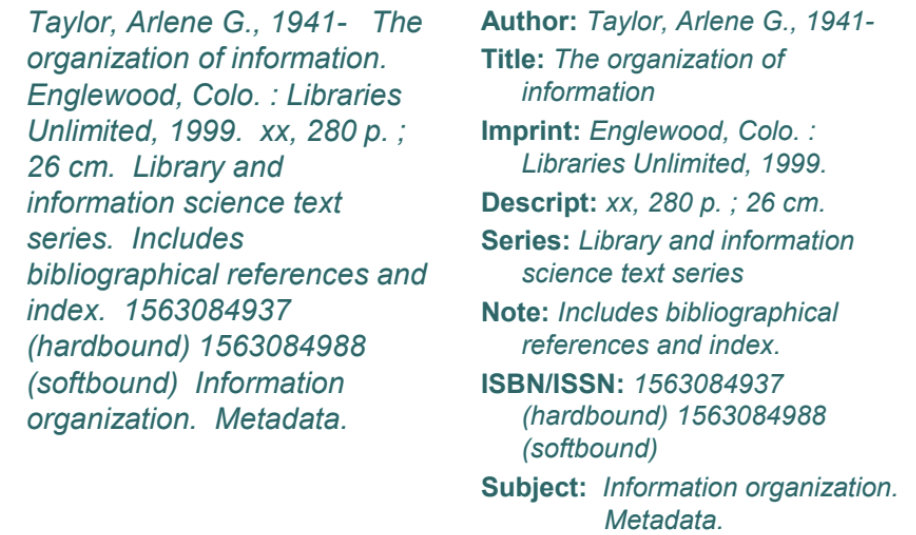
Information in the library catalog

Metadata indicates something beyond the data: a statement or statements about the data

All metadata bears the imprint of its origins and intended use when examined closely enough

  • It is “structured information that describes, explain, locates, or otherwise makes it easier to retrieve, use, or manage an information resource” (NISO, 2017:1)
  • Metadata scheme consists of metadata elements
    • Library catalog metadata scheme (MARC) contains metadata elements for title, author, subject, publisher, etc
  • Metadata element represents an attribute of the object

Purpose and Functions of Metadata

  • Purpose: represent an entity
  • Functions
    • Discovering or finding that an entity exists
    • Evaluating or selecting an entity
    • Locating or accessing an entity
    • Others such as collection management, rating content, managing intellectual property rights
  • Application areas
    • Libraries
    • Websites
    • Government agencies
    • Museums

Human Construct

  • Metadata is a human construct and not found in nature
  • It is designed to solve particular problem
  • Nothing objective about it
  • It makes subjective statement
    • what should be included
    • what should be omitted
    • where to draw boundaries
    • what terms can be used to describe it

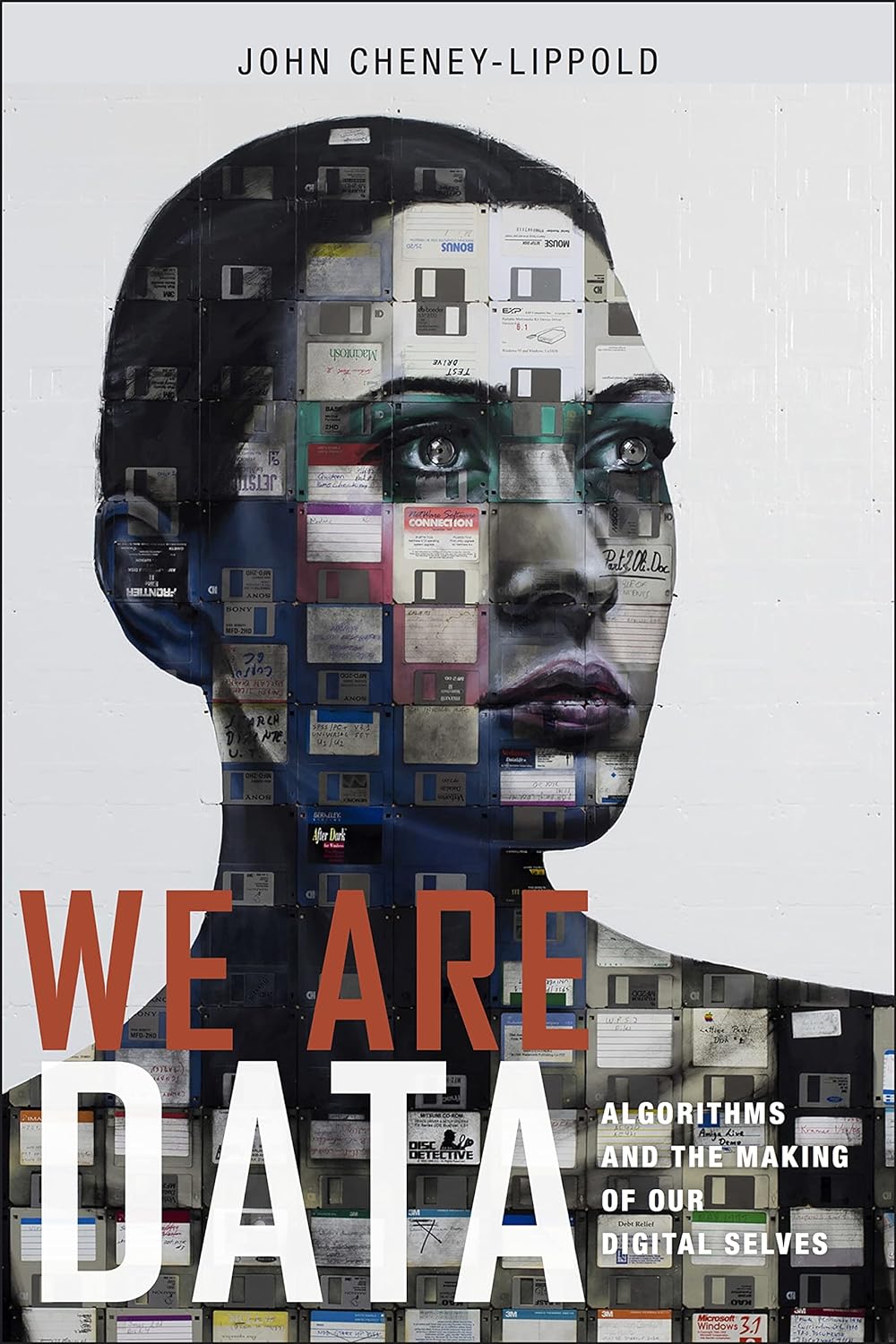
We are Data

We are filled with data in today’s networked society

  • through our web activity, we are assigned gender, ethnicity, class, age, education level, and potential status of parent with x no. of children (digital trace data/digital footprint/digital breadcrumbs)

  • if internet metadata identifies a user as foreigner than they lose right to privacy afforded to U.S. citizens

  • who would have thought that class status, citizenship, ethnicity could be algorithmically understood?
Metadata Examples
Representative Statements

  • How should we create our statements?
  • We want statements that represent the aspects of information objects that will help users meet their goals
    • i.e. to find, manage, select, locate, obtain
  • In a consistent way
    • so that users can compare descriptions
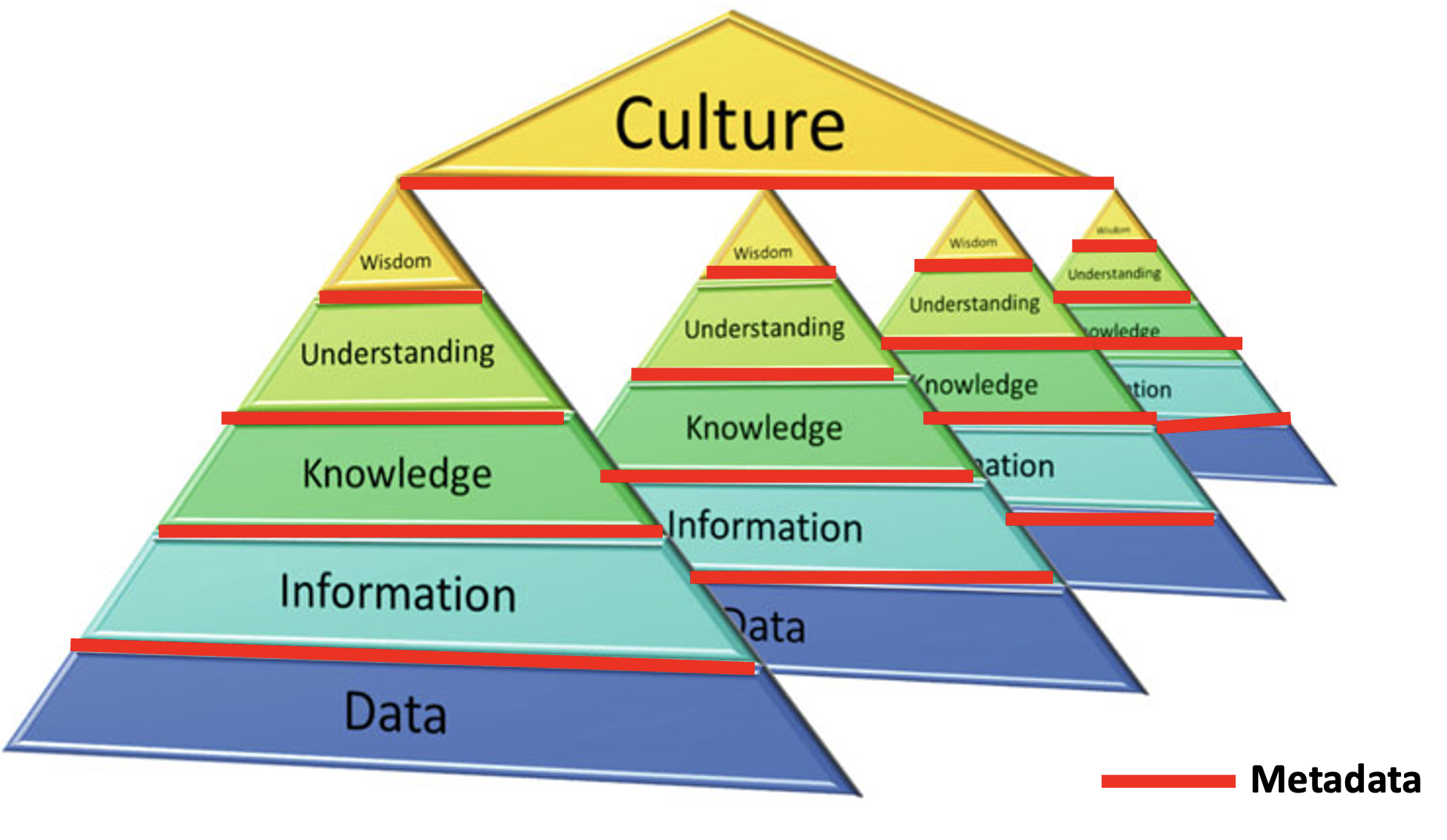
Ackoff’s Pyramid

Administrative Metadata

Metadata used in managing and administering collections and information resources

  • Examples
    • Acquisition information
    • Rights information
    • Location information

Descriptive Metadata

Metadata used to identify and describe collections and related information resources

  • Examples
    • Cataloging records
    • Finding aids

Preservation Metadata

Metadata related to the preservation management of collections and information resources

  • Examples
    • documentation of physical condition
    • documentation of preservation actions

Technical Metadata

Metadata related to how a system functions or metadata behaves

  • Examples
    • Hardware and software documentation
    • Technical details of digitization process
    • Authentication and encryption information

Use Metadata

Metadata related to the level and type of use of collections and information resources

  • Examples
    • Circulation records
    • Search logs
    • User tracking

User-Generated Metadata

Metadata generated by users online

  • Examples
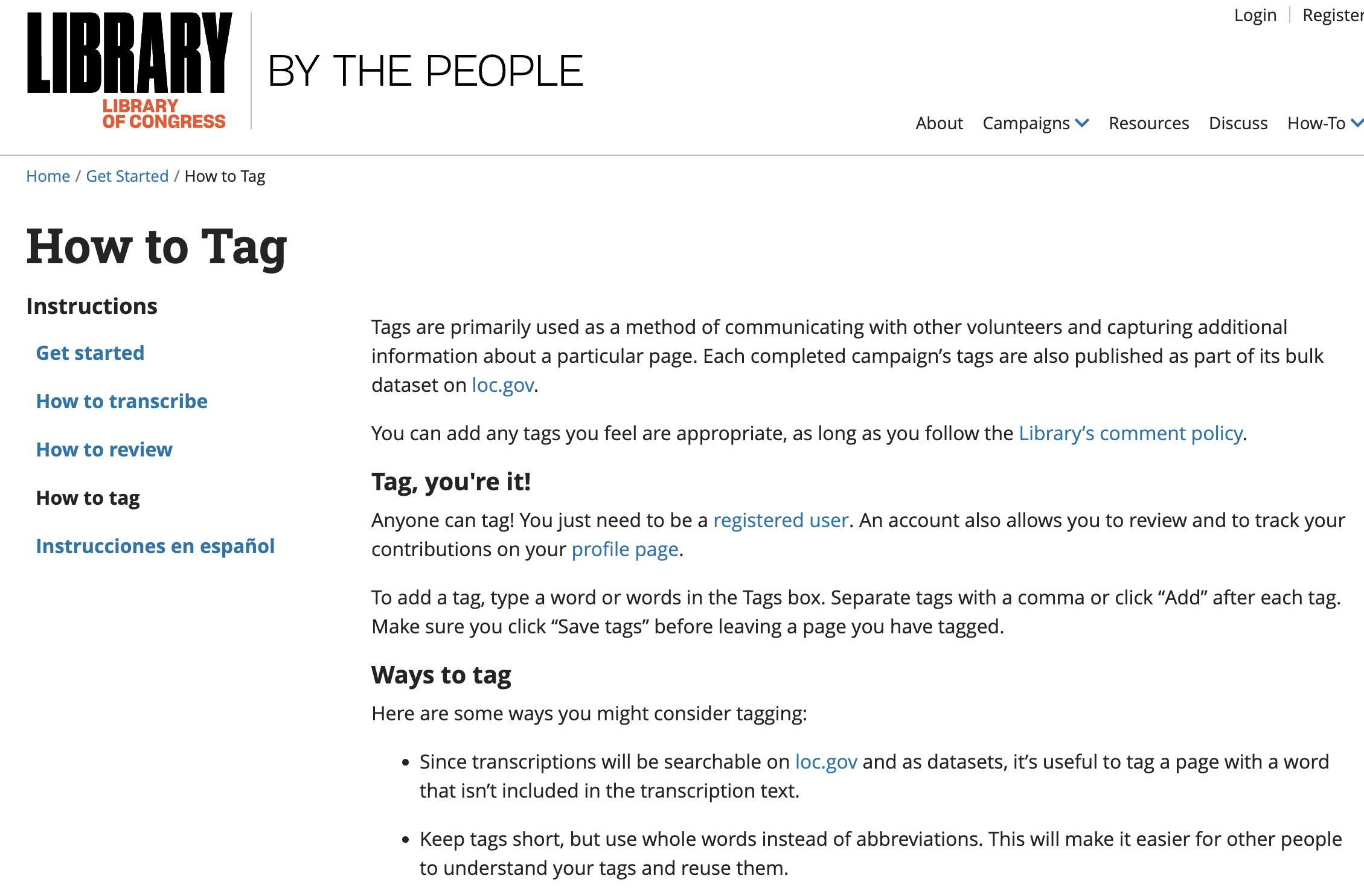
    • Social-Bookmarks
    • Reviews on Amazons and Goodreads
    • Tags on LibraryThing
    • Folksonomy (collaborative tagging, social indexing, social tagging)
    • Crowdsourcing

https://crowd.loc.gov/get-started/how-to-tag

https://crowd.loc.gov/get-started/how-to-tag

Power of Metadata: Structure

Metadata Elements and Semantics

  • Each element needs a name
  • Each element needs a definition (semantics)
  • The semantics describe the information content associated with an element
  • Input rules associated with an element
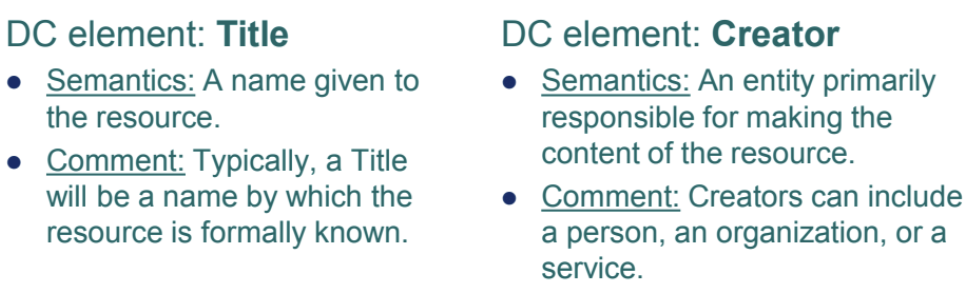
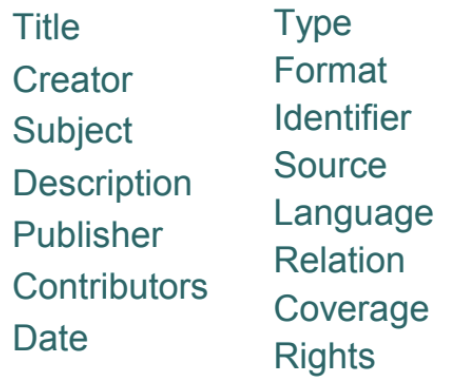
  • 15 elements to represent digital resources
  • Also used for analog resources

  • Government Information Locator Service (GILS)
    • Metadata scheme for describing government information
    • 67 elements
  • Federal Geographic Data Committee (FGDC)
    • Metadata scheme for describing geospatial information
    • 100+ elements
  • Encoded Archival Description (EAD)
    • Used within the archival community
  • And many more….
    • Visual Resources Core, MODS, etc.

Focus So Far, Upcoming Weeks

  • Structuring the representation
    • Selecting object attributes to represent (based on users, user questions, and collection’s objects)
    • Labeling attributes through the metadata elements/field names
    • Defining the elements (semantics) to indicate information about object to record
  • In a few weeks we will try some data modeling